Digital Welfare State edition 014
DWS Newsletter - edition 14
September 2026
Back to school, back to work, back to keeping up with all the goings on in the world of the digital welfare state. Hope you had a good summer break.
This month I’m featuring two great new reports; the first of which is introduced by Emmanuelle Andrews from the brilliant charity Glitch.
Rather than focus on some theoretical AI apocalypse, I’m more concerned about what’s going on right now in our automated and increasingly AI-driven welfare systems. The report from Glitch illustrates why many of us are right to be worried about the here-and-now.
The second report, from the Administrative Fairness Lab, looks at the human experience of being selected by an opaque data-driven system for a review of your benefits.
———————————————————————
Glitch’s New Report into Race and Gender Justice
Guest post from Emmanuelle Andrews, Advocacy Director Glitch
Glitch’s new report, Welf(AI)re: A Racial and Gender Injustice Analysis of AI and Automated Decision-Making in UK Social Security, examines the use of AI, algorithms and automated decision-making systems known to be used in the context of housing, Universal Credit or other benefits in the UK’s welfare system.
Taking a systematic review approach to offer a bird’s-eye view of the evidence, literature and debates on ADM systems in welfare, Glitch argue that racism and discrimination is baked into the AI-ification of services, that the use of data and algorithms further embed and reinforce unfairness and injustice, and that algorithmic tools may lead to racialised people being denied access to housing and rejected from welfare claims.
Instead of acquiescing to the dogma that AI adoption is inevitable, Glitch are calling for us to imagine a different model for public services, as infrastructure which is not just built in pursuit of speed, scale, or efficiency, but meets the material needs of the people that depend on it.
If you’d like to contact Glitch about the report, you can email info@glitchcharity.co.uk.
Glitch are also running a series of AI literacy workshops for Black women and Black gender-expansive people to help increase AI literacy and knowledge of AI and automated decision-making - you can sign up to express your interest here.
——————————————————————————-
Targeted Case Reviews: new report from the Administrative Fairness Lab
Targeted Case Reviews (TCRs) are being used to reassess over a million Universal Credit awards every year, generating £1.1 billion in savings in 2025-26, but also putting individuals through intrusive and complex investigations.
TCRs are a major anti-fraud and error initiative, forecast to save £13 billion by the end of the decade, but only 21% of reviews find any under- or over-payment, meaning hundreds of thousands of people are being put through unnecessary investigation and stress. There is no publicly available information about how and why cases are selected for review. The best I’ve been able to find is that some kind of ‘data matching’ is used; what data from what sources is unknown at this point.
This new report from the Administrative Fairness Lab, highlights what it is like for claimants to undergo the TCR process, and makes practical recommendations for improvement.
The research identifies challenges including:
People undergoing a TCR often have little or no understanding of why they are being reviewed, or how the process will work
Claimants have to submit evidence to support their award within 14 days - a significant administrative burden particularly for people who have to provide months’ or even years’ worth of documents
Some claimants being repeatedly reviewed, sometimes only months apart
If the individual does not, or cannot, engage with the review process, their award may be suspended and ultimately terminated. Welfare rights advisers have seen people lose benefits while being investigated, only to be told that their award was correct all along
Very mixed experience of support provided by officials, with some vulnerable claimants reporting no offer of support at all
Poor communication from DWP about challenging TCR decisions.
TCRs really highlight the human cost of automated systems, particularly those which are massively opaque. When people don’t know why they are being targeted by a system, the stress and distress can be magnified, and the possibility of challenging or overturning decisions reduced. Government needs to be transparent about how the targeting in Targeted Case Reviews works.
——————————————————————————-
New book coming in 2027
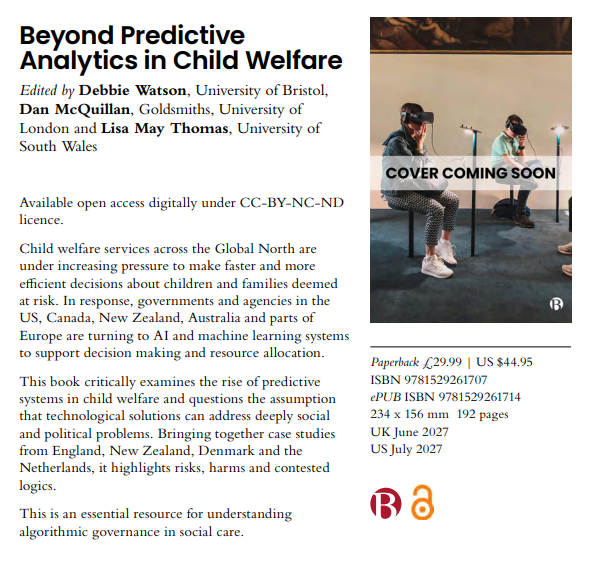
Hot off the press, I’m very excited that a book I’ve contributed a chapter to will be out next year. Beyond Predictive Analytics in Child Welfare will be published by Bristol University Press. My chapter looks at gender bias in automated welfare fraud detection; several systems used in Europe have been shown to be biased against women and single parents (who are usually women). When these women are unjustly penalised by automated, predictive systems, not only do they suffer themselves, but their children are also caught up in financial, psychological and emotional harm.
Things to read
A new tool from the Council of Europe to help identify where an algorithmic or AI-driven system is discriminatory has been released. The tool is designed for equality organisations to assess automated systems to identify discrimination, in an accessible, step-by-step way.
——————————————————————————-
In UK news, the DWP is reportedly analysing the impact of AI on both the labour market and social security and welfare system. The analysis will be used to understand the changing labour market that people are navigating, and to adjust how the welfare system provides support, for example ensuring public-facing DWP staff are kept informed about the effects of AI.
——————————————————————————-
The Open Rights Group and a group of MPs have called for greater regulation of AI use in the UK public sector, saying that the current approach lacks accountability and transparency. They highlight some of the risks of the way that government is adopting AI, including a lack of oversight or public awareness of what AI systems are being procured; the difficulty of understanding how AI systems are making decisions about our lives; and complexity in how the law might deal with mistakes and breaches of things like human rights.
——————————————————————————-
The Digital Convergence Initiative has released a framework for assessing risks in the use of AI in social protection. It’s designed to help practitioners and policymakers, among others, to assess how and when AI could be used in social protection systems, and to understand the risks of doing so.
Also from the DCI, a global evidence review of the adoption of AI in social protection - it looks like an invaluable resource for researchers, policymakers and advocates and campaigners. And a taxonomy for AI in social protection, to try to simplify and systematise the language used to describe the different kind of technologies and capabilities in use.
——————————————————————————-
In Vietnam, work is underway to combine multiple databases into a single national social security database, and for every citizen to have a digital social security record. The new database will improve the sharing, connection and use of data across the social security system, including in areas relating to children, poverty and unemployment. On paper, this could enable people to access their entitlements to support more easily, and reduce bureaucracy for individuals and the state. When they go wrong however, massive, powerful data-driven welfare systems can exclude and penalise; India’s Aadhaar is a powerful example.
——————————————————————————-
Finally a long report just out from the Joint Committee on Human Rights, part of the UK parliament, looks at the human rights implications of AI. I will admit I have not had a chance to read it yet, but it looks like a useful intervention, pointing out that governments and human rights protections are falling behind the pace of AI deployment. It looks at the risks to equality and non-discrimination, privacy and data rights, and points out the lack of any body with broad oversight and regulatory powers. One for my holiday reading perhaps!
——————————————————————————-